

SONIC RS
MAKE IT YOUR DAY.
WELCOME TO THE WORLD’S GREATEST PLAYGROUND
The SONIC RS is your ticket to that feeling when you fall into bed at the end
of the day and think “What an epic day!”
YOUR FLIGHT.
YOUR SESSION.
YOUR DAY.
With the SONIC RS, the lines between styles of flying blur. The wing fades into the background. What remains is your idea of how you want to fly today. Developed for pilots who refuse to think of their style in categories.


flow
ONE WING.
A HUGE PLAYGROUND.
The wide usable range gives you room.
The agility gives you energy.
The control gives you flow.
The intuitive handling gives you freedom.
GAMEPLAY
FREEDOM. PLAY. INTUITIVE 3D CONTROL.
The SONIC RS combines speed, agility and full control across a wide usable range. From strong-wind soaring at the coast to dynamic turns and precise proximity flying, the handling stays direct, predictable and intuitive. Clear brake inputs let you convert speed into height exactly when you want to, while the precise Mixer gives you full control over pitch and yaw.
Playful groundhandling, dynamic soaring, touch & gos or endless swoops: you don’t think. You fly. The SONIC RS follows your intuition and turns every spot into your
“WORLD’S GREATEST PLAYGROUND”.
RAST
THE SILENT BACKBONE.
RAST is the backbone of the SONIC RS. Working hand in hand with the reflex profile, it stabilizes the canopy and gives it structure exactly when it matters. It works quietly in the background so your attention stays where it belongs.
“RAST isn’t made to impress. It works in the background so you can focus entirely on your flight.”
DON’T THINK. FLY.
FORGET BENCHMARKS.
The SONIC RS wasn’t built for the next benchmark. It was built for the days you never forget: friends, high fives, that one last endless swoop. When wind, timing and your feel for the wing click perfectly and you are simply in flow. In the end it’s not the numbers that count. It’s this feeling. Some sessions end with the landing. The best ones stay.
MAKE IT A SONIC DAY!
The SONIC was simply the perfect match for our Madeira trip. Whatever the conditions, it won us over on every level and made this trip truly unforgettable.
Martin Perdacher, Swing Team PilotWHO IT’S FOR
The SONIC RS.
The SONIC RS is for pilots who don’t choose a wing by category, numbers or the next benchmark, but by the flying experience itself. With the SONIC RS, the classic boundaries blur. Developed as a true allround parakite for powerful sessions at the coast, your backyard spot and everything in between.
In the larger sizes it is intuitive and accessible enough for ambitious parakite newcomers, while staying direct, dynamic and powerful enough for experienced parakite pilots who want to get everything out of the wind, the terrain and their day.
One wing. Endless ways to play.
Features
DEVELOPMENT
The SONIC RS traces its origins to our reflex paramotor wing, the SCORPIO RS. Building on this foundation, our Italian R&D team around designer Alessio Casolla consistently evolved the concept into a parakite and kept refining it through long sessions on the South African coast, in the widest possible range of conditions.
Read moreShow less
The goal was clear from day one: an accessible allround parakite whose intuitive, predictable handling keeps as many options open for you as possible. Simple enough to build trust quickly, yet dynamic and capable enough to grow with your skills and your idea of flying.
The robust, durable construction, with DOKDO D30 on the top surface and DOKDO D20 on the bottom surface, is made for intensive sessions at the coast, on the dune and at your backyard spot. It is matched by a carefully balanced mix of line materials with high trim stability.
The shape-stable, Nitinol-reinforced sharknose works in precise harmony with the reflex profile and RAST technology. The result is a canopy that stays compact and stable across a wide speed range and gives you exactly the control you need to focus on what matters: your flight.

In paragliders with RAST, the canopy interior is divided into different (pressure) sections by one or more fabric panels, some with valves, running across the flight direction. This allows control over the airflow inside the canopy. The principle works similarly to a bulkhead, for example in tanks.
With RAST, the air compensation flows within the paraglider canopy can be regulated through defined openings. This applies both during inflation (launch) and deflation. In the event of a pressure loss, for example caused by canopy disturbances, the relative internal pressure of the CORE section increases, while the BUFFER section absorbs the introduced energy through deformation. In addition, RAST can be used as an extra tension level for the leading and trailing edge, which has a positive effect on flight comfort. Since RAST connects the ribs across the entire profile height, the construction has a stiffening effect, allowing reinforcements and/or stiffening elements to be reduced or even completely replaced by this special design.
For the SONIC RS, RAST has been optimized for the following characteristics:
The aim when positioning and adapting RAST for the SONIC RS, in combination with the reflex profile and the sharknose, was to achieve a comfortable and compact flight feeling with neutral pitch behavior and even greater canopy stability at every speed and every angle of attack. The SONIC RS inflates noticeably faster in light wind and shows no tendency to overshoot in strong wind.
On the SONIC RS, this concept is based on the reflex profile of our performance paramotor wing, the SCORPIO RS, and was specifically evolved for use in a parakite. In perfect tune with RAST technology, it keeps the canopy compact, pressurized and controllable even at low angles of attack, under strong acceleration and in dynamic flight.
The reflex geometry stabilizes pitch, reduces the tendency to frontal collapses and gives the SONIC RS extra security exactly where a parakite needs it most: during controlled depowering and in fast flight.
The result is high stability across a wide range of speeds and angles of attack, and the confidence to truly fly the SONIC RS through its entire speed range.
Nitinol wires – for maximum reflex-profile accuracy
Nitinol is a high-strength, temperature- and corrosion-resistant shape-memory alloy. The name stands for Nickel Titanium Naval Ordnance Laboratory. SWING was among the first paraglider manufacturers to adopt this material, well known from medical technology, and has used it as leading-edge reinforcement for years.
On the SONIC RS, the elaborate Nitinol reinforcements in different diameters guarantee a permanently razor-sharp leading edge and maximum profile accuracy across the entire wing. The Nitinol is partially covered to protect the fabric stretched over it from premature wear. The aerodynamic shape stays stable even through strong temperature changes or frequent packing, with no loss of performance.
All sizes of the SONIC RS are equipped with a wingtip stabilo control system that is easy to adjust to your personal preference. The system expands your steering options and allows more precise, more dynamic turns by deliberately combining the main brakes with the stabilo brakes.
The SONIC RS becomes noticeably more agile and direct: ideal for clean barrel rolls, more control on launch and while swooping, all without deforming the reflex profile.
To bring the canopy overhead even faster, hold the A-risers in your hand when pulling up the wing.
To keep the brake handles neatly in position while packing, the risers are fitted with Fidlock magnetic fasteners at the best-glide position. In an emergency you can clip the brakes in there when you need your hands free, without the wing shooting down on one side or out of control.
Important: This option is intended for genuine emergencies only. The Fidlocks are not load-tested, and the wing can start to oscillate if the brakes are left clipped in for longer.
- Shape-stable canopy profile with 3D shaping: for a smooth surface and more performance.
- Dirt-out openings on the trailing edge: so you can get rid of sand and dirt easily.
- Mini ribs: mini ribs reduce ballooning in the rear part of the canopy for a cleaner, more precise trailing edge. This reduces aerodynamic drag and supports both glide performance and precision when flaring and landing.
Colors

Green
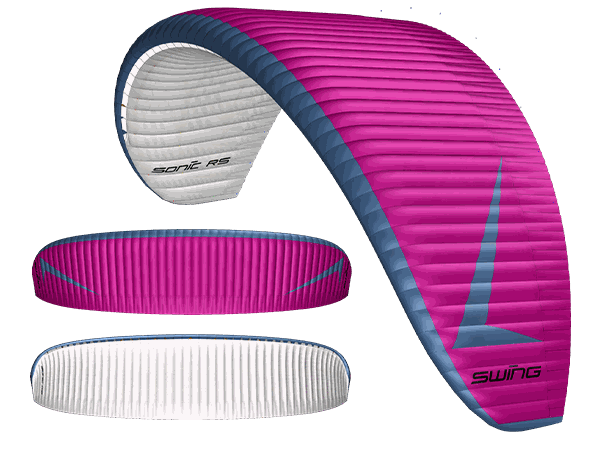
Sangria
Find your sizeClose
SONIC RANGE FINDER
Set your take-off weight and see which wingload matches your skill level and which wind window each size gives you. Take-off weight means: pilot plus wing, harness and equipment, everything on the scale together.
Certified from 50 to 119 kg, depending on size, as per the data sheet.
Wind figures are guide values from testing on flat coastal terrain and replace neither training nor a proper briefing. Always fly within the certified take-off weights given in the data sheet. The experience levels refer to pilots who already fly and are getting into parakiting, all the way up to professionals.
| SONIC RS | 15 | 18 | 21 | 24 |
|---|---|---|---|---|
| LTF certification | – | – | – | – |
| EN type certification | 926-1 | 926-1 | 926-1 | 926-1 |
| Certified take-off weight (kg) incl. equipment | 50-119 | 55-119 | 60-119 | 70-119 |
| Cells | 52 | 52 | 52 | 52 |
| Flat surface area (m²) | 15.0 | 18.0 | 21.0 | 24.0 |
| Projected surface area (m²) | 12.5 | 15.0 | 17.5 | 20.0 |
| Wingspan (m) | 9.1 | 10.0 | 11.0 | 11.8 |
| Projected span (m) | 7.2 | 7.9 | 8.7 | 9.4 |
| Max. chord (m) | 2.0 | 2.1 | 2.3 | 2.4 |
| Aspect ratio | 5.5 | 5.6 | 5.75 | 5.85 |
| Projected aspect ratio | 4.1 | 4.2 | 4.3 | 4.4 |
| Glider weight (kg) | 3.5 | 3.8 | 4.2 | 4.6 |
Size number = flat surface area in m². Sink and speed values as well as the certification number will follow once testing is complete.
- SWING SONIC RS
- Compress Bag
- Manual

BRAVE 5 – One Harness. Every Mission.
More than just a harness: the BRAVE 5 is the crucial link between you and your SONIC.

Speedbag 2
Quick-stuff bag for miniwings with a hook to attach it to your harness
DON’T THINK. FLY.
MAKE IT A SONIC DAY.
The next step is your test flight: let us help you choose!